
What is Broken in Indian MedTech Supply Chain and How It Impacts Healthcare Access
India’s MedTech supply chain faces procurement bias, import dependency, policy gaps, rising costs, and infrastructure challenges, impacting domestic manufacturers and healthcare accessibility.
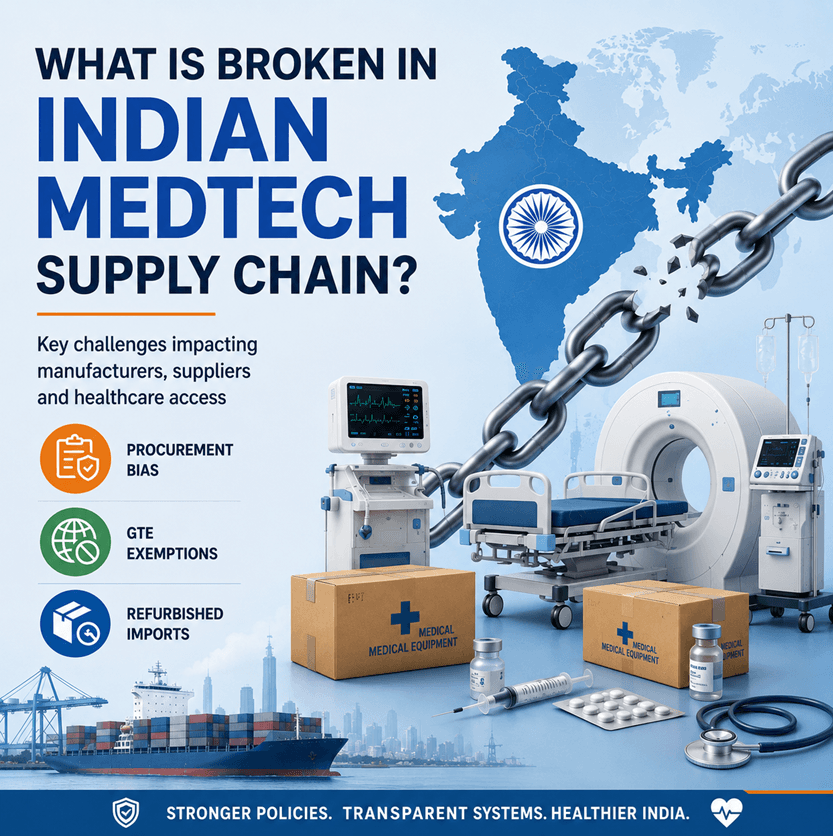
What is broken in Indian MedTech supply chain
It has been seen that The Indian MedTech value was US$12 billion in 2023 to 2024 period. Medical care technology is improving day by day and it is expected that by the end of 2030, the sector will reach a value of US$50 billion. But beyond this high value in the market, the sector is facing certain kinds of supply chain issues and this post is going to explore all those challenges.
Along with these industry-wide challenges, platforms like EquipMedy.com are helping hospitals, clinics, and healthcare providers access reliable medical equipment with better transparency and smoother procurement solutions across India. EquipMedy is continuously working towards improving healthcare accessibility by connecting buyers with trusted medical equipment suppliers and advanced healthcare technology.
After conducting huge market research, it has been identified that the Indian MedTech supply chain is disrupted due to the three most important factors which is usually considered as The Triangle Trap.
● The most important factor is the public procurement bias which threatens Indian certificates by applying the USFDA/CE certificates as the doorkeepers. The Indian licensing system focuses on the safety and security while at the same time it becomes difficult for some of the items to pass USFDA/CE certificates as high standards beyond maximum safety have been detected. Sometimes the reporting and auditing mechanisms present in the local supplier are not matching with the standard protocol creating difficulty to manage the global supply chain.
● Global tender enquiry (GTE) legislation allows products which are primarily in India but not so much market recognized in foreign countries. The policy allows Global tenders only when the India Medtech industry needs it. But it has been identified that 354 medical devices are already discarded by Department of Expenditure when they are valid till 2027. This is really a great risk for the small medical equipment suppliers present in India and sustain their economy into the market.
● Import approvals are often refurbished which leaves many second-hand medical tech items into the sector. The Ministry of Environment, Forest and Climate Change (MoEFCC) allow the medical care suppliers to supply the product which are hazard free. But in 2025 CDSCO announced that refurbished itemsspecially CTs, MRIs and Cathlabs will not be accepted and imported. India does not have a clear policy to input all this material so it becomes difficult for the supply to retrieve all those items and supply it to the desired Nation.
Recently it has been observed that the conflict occurring in west Asia is creating lots of issues for the Indian MedTech sector. As the Hormuz has exposed once again, it is becoming difficult to both export and import medical care equipment and technological needs. Even the geopolitical turbulence occurring from the last year not only created excessive pressure on the matrix sector but it also jerked the situation of local suppliers. It has been noticed that the cost of fuel, operation cost, freight cost and labor cost has significantly increased which is very difficult to manage in this present situation. It has been also reported that medical equipment cost has been increased by 15 to 20%. Such an increase in the equipment also impacted the Healthcare organization, even the hospitals. Over resilience on other industries is also an important reason for the quick down work of the Indian MedTech sector.
It has been seen that the Indian government has moved towards the lower custom duties which is creating issues for supplying the raw material. Government or still trying to create unique cargo corridors for supplying medical care equipment with advanced technologies. India is currently looking ahead to improve medical care technology and incorporate innovation into it. The main problem here is the fragmented market structure and lack of real skills, knowledge and expertise among work forces. Despite having dense knowledge of the workforce, it becomes difficult to negotiate with them in the highly competitive market structure. Lack of robust infrastructure to store the medicine as well as keeping them in the cold storage whenever required is also becoming difficult for the Indian MedTech sector. There is also a lack of implementing suitable policy that could better distribute medicine and care equally to the people even from the rural and sub rural areas.
Considering all the situations it can be said that medical care costs are increasing day by day. In order to support Quality Services to the patient and their families it is very much important to have meet and clean advance technology. Indian MedTech technology is continuously trying to expand into the globe and they are successful but the main issue lies in the change of continuous policy and legislation. Some internal forces are also there like the lack of skill, west Asian conflict, lack of appropriate infrastructure, procurement bias and global tender enquiry. Even the high operation cost and technology and lack of advance thinking are responsible for such a downward situation.
Contact
Vishu Gaur
Buy and Sell New and Pre-Owned Medical Equipment
EquipMedy
equipemedy@gmail.com
SHARE THIS
Get the latest press releases and company news delivered straight to your inbox.