
The Continuum Form: A Structured Poetic Framework Based on Lexical Progression
Makena Brandon announces The Continuum Form, a structured poetic framework centered on progression, conceptual inheritance, and thematic transformation. Moving beyond traditional rhyme-based constrain
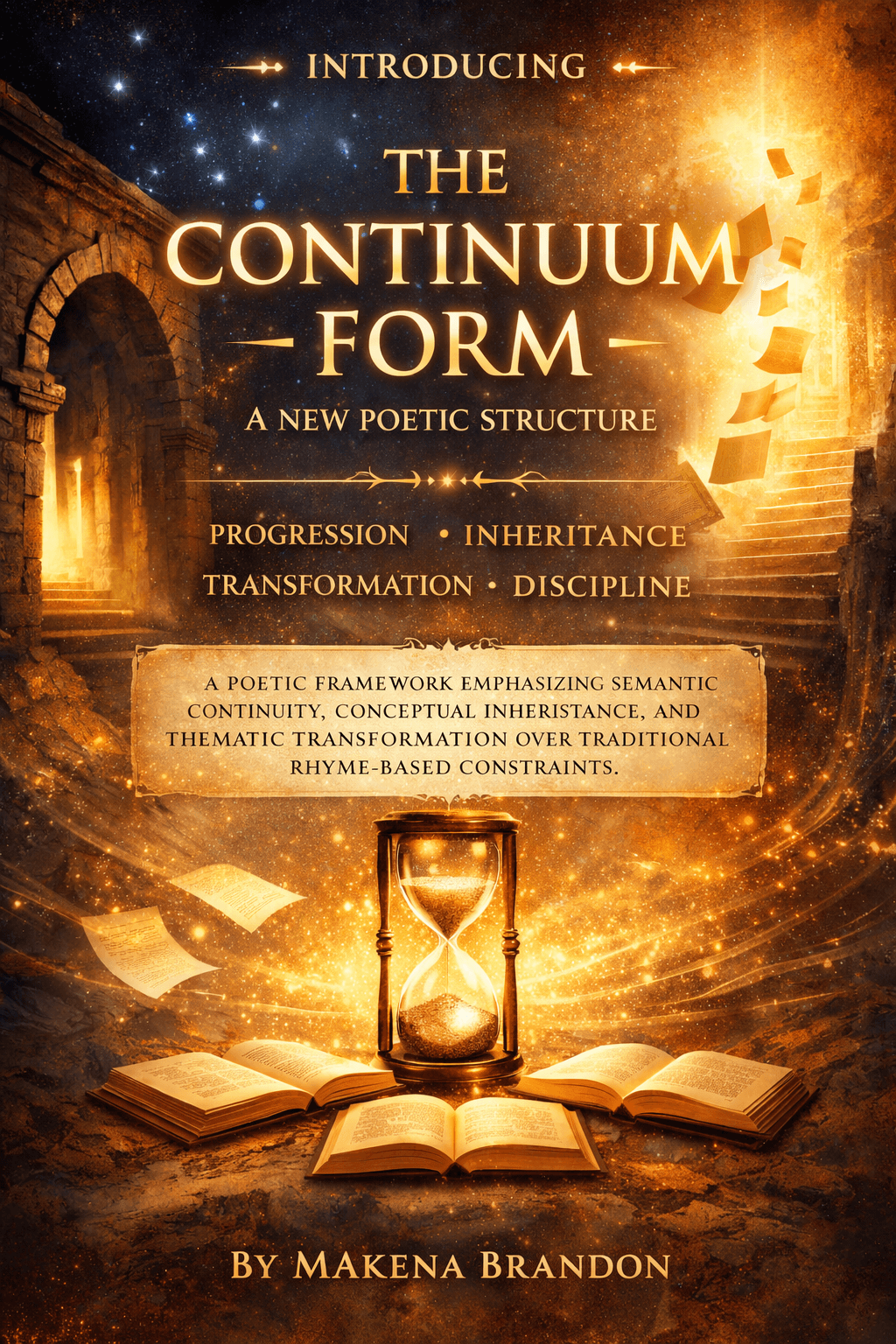
The Continuum Form: A Structured Poetic Framework Based on Lexical Progression
Makena Brandon
Abstract
This paper outlines the Continuum Form, a contemporary poetic framework structured around lexical progression and staged development. The form departs from traditional rhyme- or meter-centered organization by employing controlled word transfer between movements. Through this mechanism, thematic consequence becomes structurally embedded within the poem. The Continuum Form emphasizes progression, inheritance, and reinterpretation, positioning structure as an active agent in meaning-making.
Introduction
Poetic forms have historically relied on metrical symmetry, rhyme schemes, or syllabic constraints to generate coherence. While such devices remain effective, contemporary poetics increasingly explore alternative organizing principles. The Continuum Form contributes to this ongoing exploration by structuring progression through lexical continuity rather than phonetic repetition.
The form was developed to foreground the relationship between intention and consequence within poetic architecture. Its defining feature is a system of word inheritance that binds successive movements together at the level of language itself.
Structural Framework
Tripartite Composition
The Continuum Form consists of three sequential movements of equal length. The standard configuration comprises fifteen lines arranged as follows:
- Movement I: 5 lines
- Movement II: 5 lines
- Movement III: 5 lines
This tripartite arrangement reflects a developmental arc: initiation, continuation, and reorientation.
Lexical Continuity Principle
The defining structural mechanism is lexical progression:
The final word of each line in Movement I becomes the initial word of the corresponding line in Movement II.
This transfer ensures that Movement II emerges directly from the linguistic material of Movement I. Rather than merely advancing theme conceptually, the poem advances it structurally. Meaning is inherited, not replaced.
Compression Element
One line within the poem must consist of exactly two words.
This compression line serves as a point of rhetorical concentration. Its brevity contrasts with surrounding lines, generating emphasis and structural tension.
Terminal Reframing
The final line of the poem must consist of a single word.
This terminal word functions as a reframing device. Positioned after cumulative development, it invites retrospective reinterpretation of the poem’s trajectory.
Optional Features
Rhyme and meter are optional. While poets may incorporate them, the primary organizing force of the Continuum Form remains structural and semantic rather than phonetic.
Conceptual Orientation
The Continuum Form operates on the premise that language carries forward its own implications. By requiring terminal words to reappear as initial words, the structure mirrors processes of causation, reflection, and development.
The form is particularly suited to themes involving:
- Ambition and consequence
- Memory and reinterpretation
- Identity and transformation
- Intention and outcome
However, its framework remains adaptable across subject matter.
Adaptability and Replicability
While the standard form employs a 5–5–5 configuration, proportional adaptations may be explored provided that:
- The tripartite movement is preserved.
- Lexical progression remains structurally central.
- The compression and terminal reframing elements are maintained.
The form is designed to be teachable, repeatable, and adaptable within workshop, classroom, and publication contexts.
Conclusion
The Continuum Form represents a structured approach to poetic progression in which language itself becomes the vehicle of consequence. By embedding development within lexical transfer, the form seeks to align structure with thematic evolution.
It offers a disciplined yet flexible framework for contemporary poetic practice.
Author Biography
Makena Brandon is a contemporary writer and poet whose work explores identity, ambition, and structural experimentation in poetic form. His writing engages questions of discipline, transformation, and the architecture of meaning. The Continuum Form reflects his ongoing interest in integrating conceptual progression with formal design.
Contact
Annrose Wanjiru
Editor
Makena Brandon
annrosewanjiru765@gmail.com
SHARE THIS
Makena Brandon
Professional Services
Makena Brandon is a poet focused on structured poetic development and thematic progression. His work explores ambition, discipline, youth aspiration, and the internal architecture of becoming. He is the developer of The Continuum Form, a structured poetic model centered on progression and conceptual inheritance.
Get the latest press releases and company news delivered straight to your inbox.