India’s Kitchens Are Going Back 50 Years — Why Traditional Materials Are Making a Modern Comeback
India’s kitchens are returning to wood, brass, and cast iron as homeowners embrace durability, craftsmanship, and conscious living, with brands like Amra Farms leading this revival.
Palakkad, Kerala, India, May 18, 2026 pressrelease.in -
For years, the modern Indian kitchen was seen as a symbol of progress. Glossy laminates replaced wooden cabinets. Plastic containers took over steel dabbas. Lightweight synthetic tools became the standard, promising convenience, affordability, and ease.
In many ways, this transformation reflected India’s rapid urban growth. As homes became more compact and lifestyles more fast-paced, kitchens evolved to match. Utility took precedence over tradition. Speed overtook craftsmanship.
But something interesting is happening across Indian homes today.
Quietly, steadily, and with growing conviction, kitchens are beginning to look a little more like they did fifty years ago.
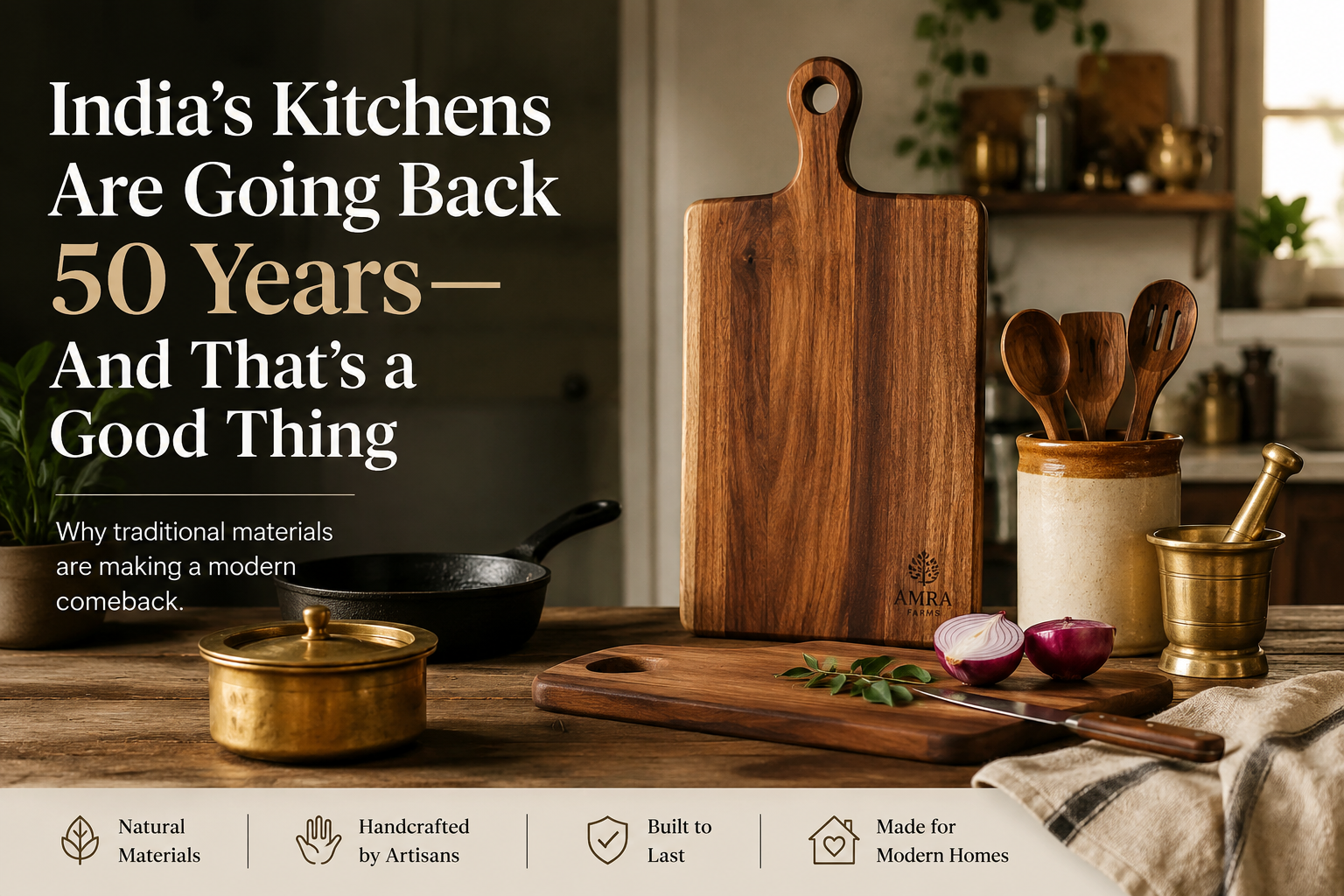
Cast iron cookware is replacing non-stick pans. Brass utensils are finding their way back onto shelves. Stone mortars and hand grinders are returning to countertops. And perhaps most noticeably, natural wooden chopping boards are replacing plastic cutting surfaces in homes that once considered synthetic the smarter choice.
At first glance, this shift may appear nostalgic. But it is not about sentimentality.
It is about value.
Across India, consumers are rediscovering traditional materials not because they are old-fashioned, but because they align with the needs of modern living: durability, sustainability, authenticity, and timeless design.
In a country racing toward the future, the kitchen is becoming one place where looking back is beginning to make perfect sense.
The End of Synthetic Convenience
For decades, plastic dominated the Indian kitchen.
It was affordable, widely available, easy to clean, and marketed as the hallmark of a modern household. Whether it was cutting boards, storage containers, serving trays, or kitchen tools, synthetic materials became the default choice for millions of homes.
But over time, the limitations of this convenience have become difficult to ignore.
Plastic products often wear out quickly, develop visible damage, lose their appearance, and need frequent replacement. What initially seems economical often turns into a cycle of repeated purchases.
Modern consumers are becoming increasingly aware of this pattern.
Rather than buying low-cost kitchen products every few months, many households are choosing to invest in products designed to last for years.
This marks a broader change in Indian buying behaviour.
Consumers are moving away from disposable utility and toward lasting quality.
The kitchen, once viewed purely as a functional space, is now being treated with the same thoughtfulness people once reserved for living rooms and bedrooms.
Every item placed in it is being chosen with greater intention.
India’s Premium Home Movement
This shift is closely tied to another powerful trend shaping the Indian market: premiumisation.
Across urban and emerging tier-two cities, homeowners are spending more on fewer but better things.
The focus is no longer simply on owning products. It is on owning products that reflect craftsmanship, individuality, and permanence.
This change can be seen across categories:
Handmade ceramics replacing mass-produced dinnerware
Solid wood furniture replacing engineered alternatives
Artisanal décor replacing factory-made accents
Traditional cookware returning to contemporary kitchens
The kitchen has become a central expression of this evolution.
Open kitchens, island counters, aesthetic storage solutions, and carefully curated accessories are now standard aspirations for India’s modern homeowner.
In this environment, utility products are no longer invisible.
Even something as everyday as a chopping board has become part of a larger design language.
Consumers want kitchen tools that work well, look beautiful, and tell a story.
That is precisely why traditional materials are making their comeback.
Why Wood Is Leading the Revival
Among all traditional materials returning to Indian kitchens, wood has emerged as one of the strongest symbols of this shift.
There is something inherently grounding about wood.
Its texture, warmth, and natural grain bring character into a space often dominated by steel, stone, and glass.
But its growing popularity is not simply about appearance.
Wood represents longevity.
A well-crafted hardwood chopping board can remain part of a kitchen for years, often ageing beautifully rather than deteriorating.
It becomes more than a tool.
It becomes part of the home.
This permanence resonates strongly with today’s buyers, who increasingly seek products that feel substantial rather than disposable.
The appeal is also emotional.
Many Indians associate wooden kitchenware with childhood memories—homes where cooking was slower, meals were more intentional, and tools were passed down rather than replaced.
Today’s resurgence of wooden kitchen products reflects a desire to reconnect with that sense of authenticity while integrating it into contemporary lifestyles.
It is tradition, reimagined.
The Return of Conscious Kitchens
Another reason for this movement is the rise of conscious consumption.
Modern Indian buyers are asking sharper questions before making purchases.
How long will this last?
Where was it made?
Who made it?
Does it add value beyond convenience?
These questions are changing how kitchens are built and stocked.
Consumers are increasingly rejecting the idea that “new” automatically means “better.”
Instead, they are embracing products rooted in craftsmanship and material integrity.
This mindset is driving demand for kitchenware that feels intentional rather than industrial.
The return to wood, brass, cast iron, and stone reflects this broader search for authenticity.
The kitchen is becoming a place where people want to feel connected—to their food, their routines, and the materials they interact with daily.
Kerala’s Craftsmanship Finds New Relevance
Nowhere is this revival more meaningful than in regions with deep traditions of woodcraft.
Kerala, long known for its relationship with timber craftsmanship, is seeing renewed appreciation for its artisanal woodworking heritage.
Techniques once associated with traditional household tools are finding new life through contemporary kitchenware.
This is where brands like Amra Farms are becoming part of an important new chapter.
Drawing from Kerala’s natural hardwood traditions, Amra Farms creates handcrafted wooden chopping boards that combine timeless material quality with modern functionality.
Each board reflects the principles that are driving India’s kitchen revival: durability, simplicity, and authenticity.
Made using carefully selected hardwoods such as teak and neem, these boards represent a quiet but significant shift in how kitchen essentials are perceived.
They are no longer disposable accessories.
They are intentional investments.
For many homeowners, choosing handcrafted wooden kitchenware is about more than utility.
It is about bringing warmth, craftsmanship, and permanence into one of the most important spaces in the home.
A Return That Looks Forward
India’s kitchen transformation is not about rejecting modernity.
It is about refining it.
The return to traditional materials is not a step backward. It is a more thoughtful step forward.
As Indian homes continue to evolve, the products that endure will likely be those that balance heritage with contemporary relevance.
Wooden chopping boards, cast iron cookware, brass accents, and other natural materials are not returning because they are fashionable.
They are returning because they offer something increasingly rare in a fast-moving consumer world: substance.
Sometimes progress is not about replacing the past.
Sometimes it is about recognising what worked, understanding why it mattered, and bringing it forward with renewed purpose.
India’s kitchens may indeed be going back fifty years.
And that may be exactly what modern homes need.
AdMarkon Marketing Online Pvt. Ltd
CEO